The beginning of the lineage depends on which fossils are classified as Neanderthal or ancestral Neanderthal.
COMPARE THE RECONSTRUCTION STANDARD
One method. Different evidence.
HOLISTIC RECONSTRUCTION · CLAIM-LEVEL EVIDENCE
What did a
Neanderthals life
actually contain?
End-to-end Phase 1 prototype connecting claims, sources, reconstruction layers and public interfaces. Every layer separates observation, inference, reconstruction and the unknown.
Probable reconstruction · moderate confidence
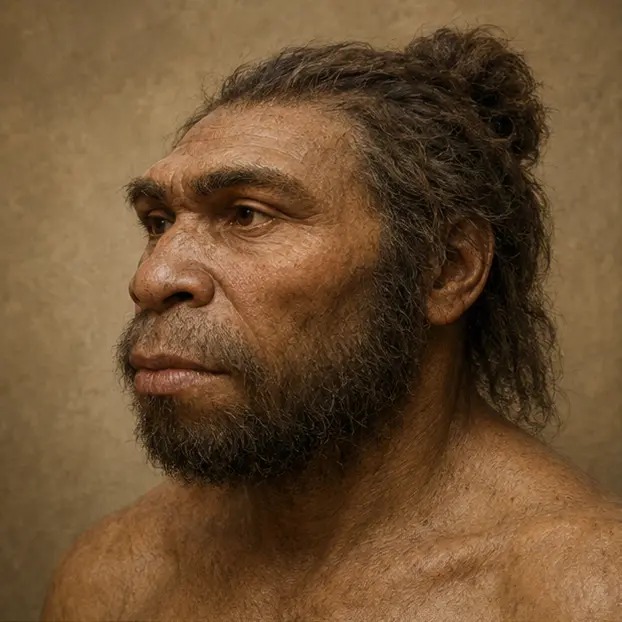
Body and face
Fossils constrain robust proportions and craniofacial anatomy; skin, hair, scars and individual appearance remain interpretive.- What is known
- Robust skeleton, characteristic cranial anatomy and substantial regional and individual variation.
- What is inferred
- Soft-tissue depth and musculature can be reconstructed within ranges.
- What remains unknown
- A specific individual's pigmentation, hairstyle, expression and surface details.
A WHOLE LIFE, WITHOUT INVENTING ONE
Evidence in context.
Select any tile to open its three-level evidence card.REPRESENTATIVE SOURCE CHAIN
Follow the reconstruction back.
Ancestry percentages vary among individuals and populations; a single global percentage is misleading.
One regional community cannot define Neanderthal social organization across their full range and history.
Dental calculus samples are few and do not measure everything eaten or the proportion of each food.
The structures' specific purpose is unknown; ritual, shelter and other functions cannot be distinguished securely.
No cord or complete assembled object survives, so the final arrangement and meaning are inferred.
Clothing need, hide processing and preserved garments are different evidence categories; regional variation was likely.
Production methods differed and some may be simpler than earlier experimental reconstructions assumed.
