A dated view of recent findings, changing methods and competing interpretations.
18 papers checked in this update through 9 October 2026, alongside retained archive entries. Sorted by first online publication; issue dates and later news coverage do not make a paper new. This selection is not an exhaustive review.
Living research index · source check 9 October 2026. New interpretive illustration of a Moroccan cave-deposit excavation context. The Thomas Quarry fossils date to about 773 ka; the scene does not reproduce the exact excavation or identify a proven last common ancestor.
FindingGenerated representation of dating sample contexts. Suitable methods depend on material, age and depositional history; the arrangement is illustrative.
· paper published online
Imaging separates phases of Altai cave art
Hyperspectral imaging and iconographic comparisons distinguish broadly Bronze Age figures from later Tibetan Buddhist motifs at Tangbaletasi.
Why it matters
A reused painted place can preserve several visual traditions.
Evidence limits
No direct scientific dating establishes these phases; the proposed Yuan association and ritual functions remain interpretations.
Huang et al. · npj Heritage Science · Peer-reviewed · Published paper
FindingGenerated representation of materials used to investigate exchange. Appearance alone cannot establish origin, route or the terms under which goods moved.
· paper published online
Slag reveals a late-Tang iron-casting workshop
Slag chemistry, artifacts and ceramic molds support melting and casting at Zhujiazui, Hubei, between the late eighth and early tenth centuries CE.
Why it matters
Waste materials help distinguish casting from primary ore smelting.
Evidence limits
The conclusion concerns the excavated area. Proposed flux ingredients and wider supply networks remain uncertain.
FindingGenerated representation of an ancient-biomolecule workspace. Molecular survival and contamination vary, and sampling can be destructive.
· paper published online
Gut microbes carry traces of human migration
Genomic comparisons of present-day Tsimane and Hadza microbiomes reveal microbial divergence consistent with prehistoric movements of their human hosts.
Why it matters
Microbial evolution offers another line of evidence about long human histories.
Evidence limits
These are inferences from contemporary samples, not recovered prehistoric genomes. Health consequences of microbial loss remain uncertain.
Carter et al. · Nature · Peer-reviewed · Published paper
FindingGenerated representation of food-reconstruction evidence. Residues and plant remains can inform ingredients and processing; complete recipes often remain uncertain.
· paper published online
A Xinjiang brazier preserves burned plant residues
Chemical residues identify cannabis and signals associated with aromatic plants in a repeatedly scorched wooden vessel from Hongshan Cemetery.
Why it matters
Residues add material evidence to interpretations of Iron Age plant use.
Evidence limits
One vessel does not establish regional practice, inhaled dose or intoxication. Ritual function is inferred from context.
Song et al. · npj Heritage Science · Peer-reviewed · Accepted manuscript
FindingGenerated representation of food-reconstruction evidence. Residues and plant remains can inform ingredients and processing; complete recipes often remain uncertain.
· paper published online
Coastal diets shifted as rice farming expanded
Jingtoushan animal isotopes and regional comparisons suggest a Neolithic shift from marine foods toward terrestrial C3 resources in the Lower Yangtze.
Why it matters
Dietary transitions can be examined alongside changing coastal livelihoods.
Evidence limits
Dog diets only indirectly inform human food use. C3 signals do not identify rice alone.
Deng et al. · npj Heritage Science · Peer-reviewed · Accepted manuscript
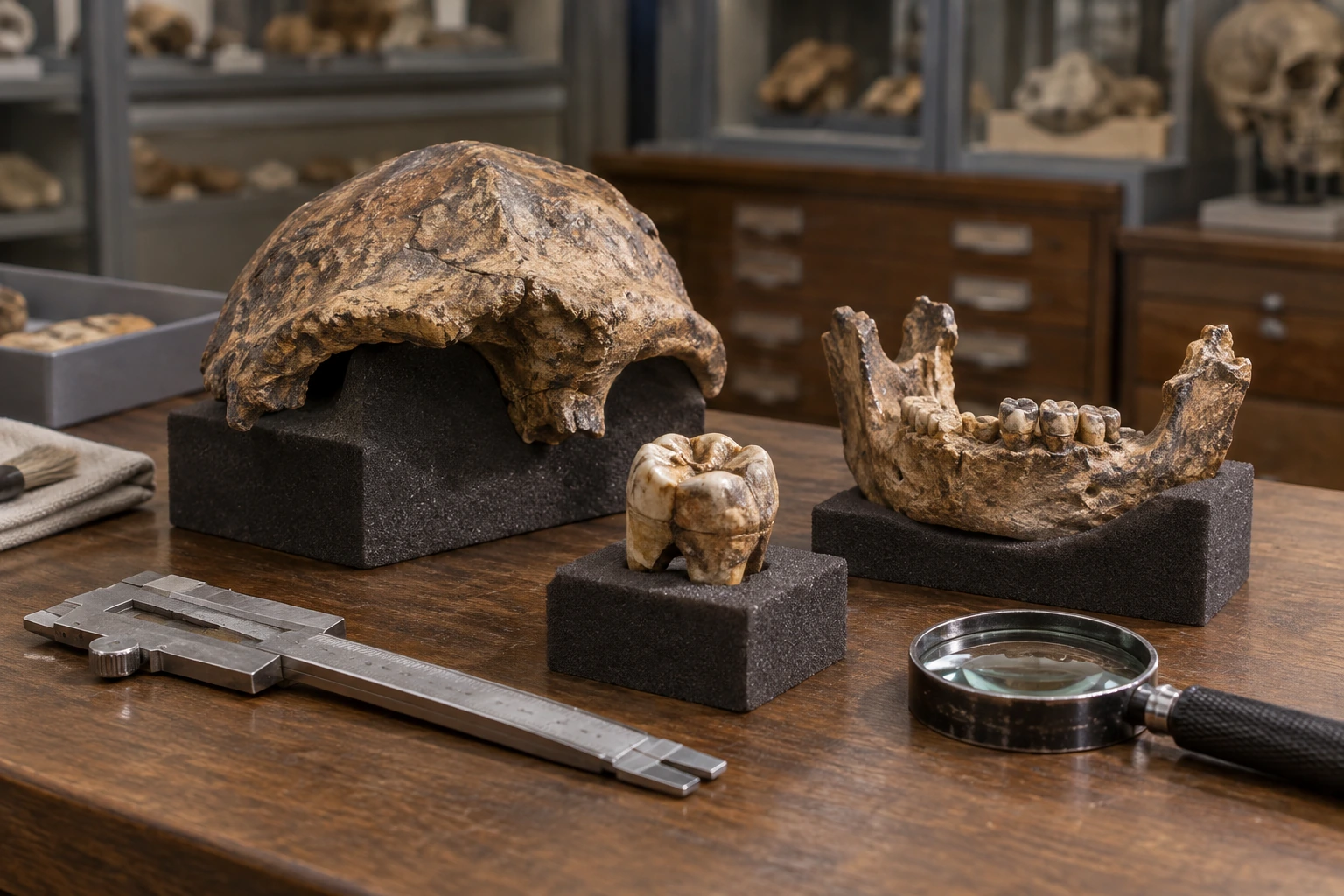
FindingGenerated representation of comparative fossil study, using casts at different scales. Fossil form, names and molecular lineages do not always align neatly.
· paper published online
Adult Drimolen fossil strengthens early erectus evidence
Eighteen described fossils include adult skull fragment DNH 127, tentatively assigned to Homo erectus sensu lato in a roughly 2.04–1.95-million-year context.
Why it matters
An adult specimen adds to the earlier juvenile evidence at Drimolen.
Evidence limits
This supports an already proposed early presence in southern Africa; it does not locate the species’ origin or settle all taxonomic boundaries.
FindingGenerated representation of crop diversity and seed stewardship. Domestication involves continuing relationships and selection, not one universal linear sequence.
· paper published online
Livestock expansion coincided with Madagascar’s landscape change
Radiocarbon dates and isotopes trace rapid livestock spread into Madagascar’s interior about 1,200 years ago, followed by changes in animal diets and vegetation.
Why it matters
Pastoral land use adds context to endemic megafaunal decline.
Evidence limits
Association does not establish livestock as the sole extinction cause. Carbon changes can reflect C4 grasses or CAM succulents.
TrendGenerated representation of an ancient-biomolecule workspace. Molecular survival and contamination vary, and sampling can be destructive.
· paper published online
Cell experiments trace the evolution of human cartilage
Regulatory assays and comparative cells identify changes in skeletal gene activity, including reduced glycosaminoglycan production in human cartilage relative to other apes.
Why it matters
The study connects genetic regulation with a material component of skeletal evolution.
Evidence limits
Cell assays identify candidate mechanisms; they do not reconstruct an extinct individual or establish personal disease risk.
Yan et al. · Nature · Peer-reviewed · Published paper
FindingGenerated representation of crop diversity and seed stewardship. Domestication involves continuing relationships and selection, not one universal linear sequence.
· paper published online
Belize soils record a move toward upland farming
Southern Belize evidence places cultivation beside wetlands around 6,000 BP and upland farming by 3,500 BP, alongside maize intensification and settlement growth.
Why it matters
Farming locations changed as communities managed environmental uncertainty.
Evidence limits
This is a regional sequence. C4 signatures alone are not crop-specific, and climatic or demographic drivers remain interpretations.
TrendGenerated representation of dating sample contexts. Suitable methods depend on material, age and depositional history; the arrangement is illustrative.
· paper published online
Animal remains test how long Neanderthals stayed
Statistical comparisons distinguish brief stopping places better than prolonged stays from repeated short visits in Neanderthal-associated assemblages.
Why it matters
Rich deposits can combine multiple occupation episodes.
Evidence limits
Overlapping activity blurs the signal; faunal indicators need other dating and contextual evidence.
Lubrano et al. · Journal of Archaeological Method and Theory · Peer-reviewed · Published paper
FindingGenerated representation of dating sample contexts. Suitable methods depend on material, age and depositional history; the arrangement is illustrative.
· paper published online
Tooth isotopes reveal a persistent Levantine refuge
Herbivore enamel from three Lebanese sites records recurring Mediterranean seasonality and woodland resources across sampled intervals around 400,000–100,000 years ago.
Why it matters
Locally buffered habitats could support repeated hominin presence and movement.
Evidence limits
Sparse samples and legacy collections cannot demonstrate uninterrupted occupation or uniform conditions throughout the Levant.
Russo et al. · Communications Earth & Environment · Peer-reviewed · Published paper
FindingGenerated representation of collaborative collections care. The image does not establish ownership, consent or authority to share restricted knowledge.
· paper published online
Old Lebanese collections yield new ecological evidence
Renewed dating, animal-bone study and dental wear analyses reconstruct persistent coastal woodlands and differences in hominin resource use.
Why it matters
Museum collections can address geographic gaps without a newly excavated fossil.
Sommer et al. · Quaternary Environments and Humans · Peer-reviewed · Journal pre-proof
FindingNew interpretive setting for Bianfu Cave in southwestern China. Denisovan fossil ages and the wider cultural sequence are distinct; the image claims no known appearance, clothing, shelter plan, or artifact attribution.
· paper published online
Bianfu extends the Denisovan evidence record
Proteins identify two teeth and three bone fragments, including a radius, as Denisovan in layers dated approximately 167–134 thousand years ago.
Why it matters
The fossils expand the molecularly confirmed geographic and anatomical record.
Evidence limits
Protein assignments are not full genomes and do not identify every fossil or occupation in the wider 190–70-thousand-year sequence.
Ruan et al. · Nature · Peer-reviewed · Published paper
FindingGenerated representation of crop diversity and seed stewardship. Domestication involves continuing relationships and selection, not one universal linear sequence.
· paper published online
Direct grain dates refine millet’s route into Europe
Seventy dates from charred millet, including sixteen new measurements, place the earliest secure European evidence in this analysis in the western Pontic Steppe.
Why it matters
Dating crop remains directly tests models of agricultural spread.
Evidence limits
Earliest sampled evidence is not necessarily the first cultivation; incomplete coverage limits precise routes and timing.
Karanikola et al. · Scientific Reports · Peer-reviewed · Published paper
FindingGenerated representation of materials used to investigate exchange. Appearance alone cannot establish origin, route or the terms under which goods moved.
· paper published online
Tool reduction tests how people learned new landscapes
Tennessee River Valley projectile points suggest Clovis toolmakers extended tool use more intensively than later Cumberland groups.
Why it matters
The authors connect this contrast to changing familiarity with stone sources.
Evidence limits
Tool reduction indirectly reflects resource decisions; it cannot reveal when individual people learned the landscape.
TrendNew conceptual illustration of ancestry inferred from genetic relationships. The interwoven strands are a visual metaphor, not a genealogy, measured result, or reconstruction of an unknown hominin’s appearance.
· archive entry
TRACE tests archaic ancestry without reference genomes
Ancestral recombination graphs help infer contributions from unsampled archaic populations.
Why it matters
A statistical signal cannot by itself name a fossil species, reconstruct its appearance or prove a single migration route.
Evidence limits
Follow the linked source, replication and subsequent correction history.
FindingNew conceptual close-up of micro-destructive enamel sampling. The naledi study found no convincing male markers in its sampled individuals; this does not establish an all-female assemblage or a burial practice.
· archive entry
Homo naledi enamel proteins complicate sex estimates
Enamel from 23 specimens representing at least 20 individuals yielded no convincing male-specific marker. Preservation and detection limits prevent treating this as proof of an all-female group.
Why it matters
Negative molecular results can be scientifically useful when they expose assumptions in reconstruction.
Evidence limits
Follow the linked source, replication and subsequent correction history.
FindingNew ancient-DNA laboratory illustration for genomic work on late Neanderthals from Belgium and France. It depicts a generic workflow, not the study’s staff or a genome result; conclusions remain regional and sample-bounded.
· archive entry
Twenty-seven late Neanderthals enter the genomic record
Expanded genetic sampling, especially from Belgium, gives demographic models a population-scale test.
Why it matters
Extinction explanations should be evaluated across connected populations, not iconic individuals.
Evidence limits
Follow the linked source, replication and subsequent correction history.
TrendNew conceptual enlargement inspired by enamel’s bundled hydroxyapatite crystals. It is not microscopy data, a measured crystal map, or a specimen-specific account of diet.
· archive entry
Tooth nanostructure becomes a dietary archive
Researchers are connecting enamel crystal organization with food hardness and long-term dietary change.
Why it matters
Material structure adds another evidence layer beyond tooth shape, chemistry and wear.
Evidence limits
Follow the linked source, replication and subsequent correction history.
FindingNew conceptual material study of enamel-protein sampling. The study examined six Chinese fossils; this generic fragment is not a depiction of one of those specimens, and protein evidence is not a complete genome.
· archive entry
Chinese Homo erectus gains a molecular signal
Enamel proteins from six individuals provide a new molecular line of evidence for East Asian population relationships.
Why it matters
Proteins can reach time depths and climates where recoverable DNA is scarce.
Evidence limits
Follow the linked source, replication and subsequent correction history.
FindingNew interpretive environmental study for eastern African hominin diversity. The evidence concerns regional overlap over time; the scene does not place four named taxa together at one site or in a single layer.
· archive entry
Several early hominin lineages overlapped in eastern Africa
Ledi-Geraru fossils support overlapping early Homo and Australopithecus; regional diversity should not be mistaken for a single four-species community.
Why it matters
Coexistence changes how gaps, ancestry and ecological competition should be modeled.
Evidence limits
Follow the linked source, replication and subsequent correction history.
TheoryGenerated representation of comparative fossil study, using casts at different scales. Fossil form, names and molecular lineages do not always align neatly.
· archive entry
Eastern Asian archaic humans may require new names—or fewer names
Homo longi and Homo juluensis proposals compete with population-level interpretations tied to Denisovan evidence.
Why it matters
Taxonomic names organize evidence, but can imply boundaries the evidence has not demonstrated.
Evidence limits
Follow the linked source, replication and subsequent correction history.
FIELD DIRECTION
Evidence from more angles.
These are editorial reading themes, not claims of field-wide consensus.
01 · FOSSILS & CONTEXT
Presence is not an origin story
Newly described fossils refine known populations. A local occurrence does not establish where a whole lineage first evolved.
02 · MOLECULES & METHODS
Different records answer different questions
Proteins, isotopes and modern genomes widen the evidence. Their preservation, sampling and inference limits remain distinct.
03 · CULTURE & ECOLOGY
Change is regional
Farming, technology and resource use followed different histories. A local pattern is a comparison point, not a universal stage.


 Finding