

Loading map geography…
TIME · PLACE · HUMANITY
AtlasEvery place has a past.
Follow one story through time and place. Choose an era, explore the evidence, and switch views without losing your place.
The earliest candidate near our branch
Explore early cultural worlds →Sahelanthropus is one of the oldest proposed hominins. Its position and locomotion remain debated, so the map begins with a candidate—not a declared ancestor.
Layers & map controls
Hold Ctrl or ⌘ while scrolling to zoom the map. On touch screens, use the zoom and pan buttons; ordinary gestures still scroll the page.
Regional markers are reference points, not complete species distributions. Dates summarize sampled evidence; gaps do not prove absence or extinction. History trails are OFF. Modern geography is shown for orientation.
Regional contextLineage hypothesisSchematic movementInterbreeding
TIME
The timeline
Choose a milestone to move both views. Spacing follows sequence, not elapsed time.
At c. 7 Ma ago · 2 records
Across the archive
AT THE SELECTED TIME
Evidence list
| Record | Type | Time range | Evidence | Action |
|---|---|---|---|---|
| Sahelanthropus tchadensis | species | c. 7 Ma ago–c. 6 Ma ago | debated | |
| Earliest possible hominins | Evolution | c. 7 Ma ago | Timeline context · geographic coverage varies |
How marks carry meaning
- Circle · regional context
- Line · lineage hypothesis or movement
- Dotted line · interbreeding hypothesis
- Dot · dated event
- Diamond · modern discovery
Lines connect broad regions schematically; they do not establish direct ancestry, exact travel routes or precisely located interbreeding. Deep-time ages use Ma (million years ago) and ka (thousand years ago); recent dates use BCE/CE. Evidence intervals are approximate and do not imply continuous occupation.
Sources: Early Homo, 2015 · Ledi-Geraru, 2025 · Misliya, 2018 · Homo sapiens today
VISUAL SPECIES COMPARISON
Compare what matters.
Dates and ranges are approximate. Evidence summaries support comparison; the archive does not assign numerical scores to technology, food or contact.
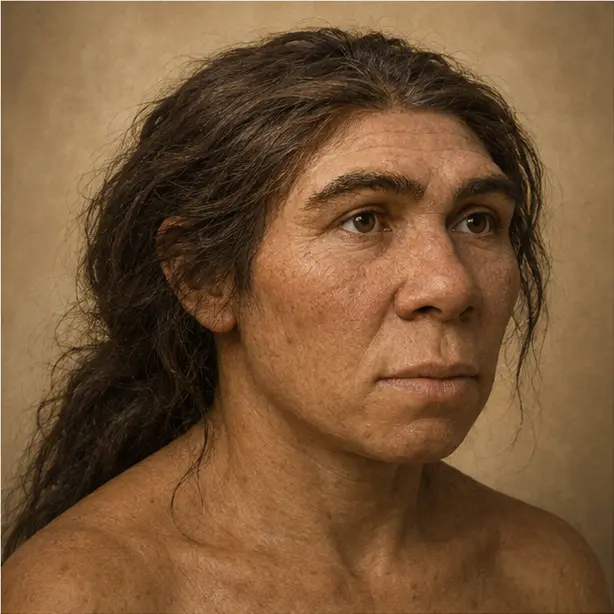
Neanderthals
c. 400 ka ago → c. 40 ka agoA
302k years
B
360k years
A
African origins; worldwide today
B
Regional context marker; full distribution is not reconstructed
A
Middle Stone Age → digital
B
Mousterian and later industries
A
Foraging → planetary food systems
B
Large and small game, plants, coastal foods
A
Structured African populations; later global dispersal and admixture
B
Interbred with sapiens and Denisovan-related populations
RELATED EXPLAINERS
Watch, question, verify.
YouTube previews link to the original video. If a preview is unavailable, a clearly labeled archive illustration appears. Verify scientific claims against primary sources.
 WATCH ON YOUTUBE ↗
▶Crash Course World History
Rethinking Civilization
Challenges the category instead of treating it as a neutral box.Open on YouTube ↗ WATCH ON YOUTUBE ↗
▶Crash Course World History
Mesopotamia
Compact introduction to cities, labor, states and evidence.Open on YouTube ↗ WATCH ON YOUTUBE ↗
▶Crash Course World History